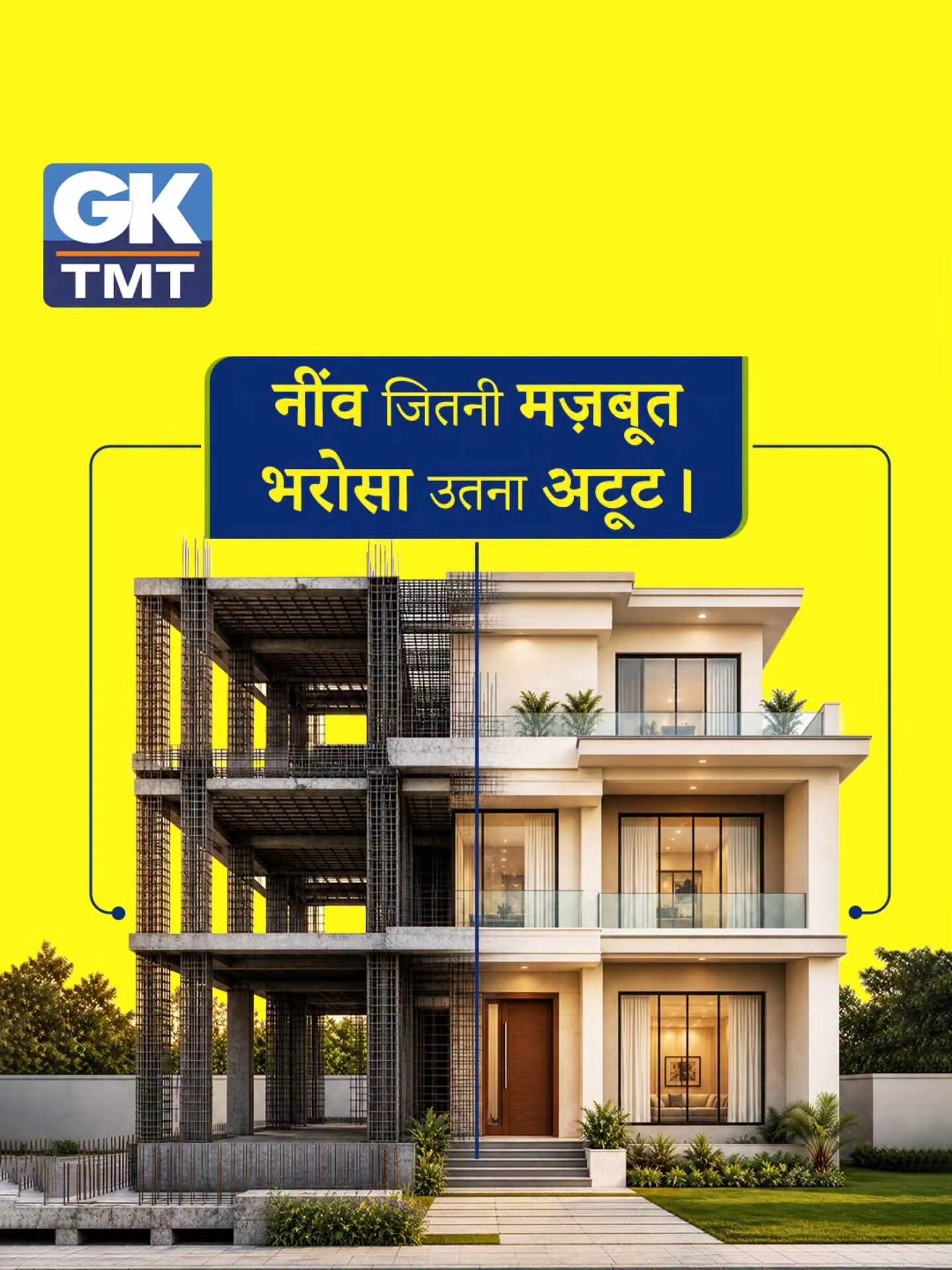

Most homes use Fe 500D grade TMT bars, compliant with IS 1786:2008, in sizes between 8mm and 20mm depending on which part of the structure they're reinforcing. Fe 550D only comes into play if your structural engineer's design specifically calls for it — it isn't an automatic upgrade. Beyond grade, the two things that actually protect you as a buyer are correct sizing per structural element and verifying the steel that shows up is what was promised.
A TMT bar is a steel rod used to reinforce concrete in a building, and it's the reinforcement material at the core of almost every house construction project in India. It's treated with heat and quick cooling so the outside is hard and the inside stays flexible — that combination is what stops a concrete structure from cracking under everyday stress. GK TMT is one of the TMT brands supplying this reinforcement steel for house construction across India — from individual homes to metro rail infrastructure. Everything below answers the specific questions people actually ask when they're buying TMT bars for a house.
Before You Talk to Your Contractor, Decide These Three Things
The rest of this page walks through each of these in order.
Fe 500D and Fe 550D aren't "better and best" — they're suited to different jobs. Fe 500D has a minimum yield strength of 500 N/mm² and a minimum elongation of 16%, which makes it flexible enough to handle the small, constant movements every building goes through — thermal expansion, minor settling, everyday load shifts — without cracking. Fe 550D pushes yield strength up to 550 N/mm² minimum, but elongation drops to 14.5% minimum — more strength, slightly less give.
|
|
|
|
|
|
|
|
|
|
|
|
|
|
|
If a dealer pushes Fe 550D for a standard two-storey home without your engineer having asked for it, that's a fair question to push back on — it adds cost without a structural reason behind it.
TMT bars aren't one-size-fits-all across a building — different elements carry different loads and use different diameters:
None of these numbers replace your structural engineer's Bar Bending Schedule (BBS) — this is what "normal" looks like across most residential jobs, not a substitute for your specific drawings.
There's no single number that applies to every house — it depends on your design, floor count, and spans. That said, a commonly used industry rule of thumb puts residential TMT requirement at roughly 4 to 5 kg per square foot of built-up area, and TMT as a category typically works out to around 15–20% of total construction material by weight, translating to roughly 10% of overall project cost. Treat this as a planning-stage sanity check, not your final order quantity — confirm the real figure against your engineer's Bar Bending Schedule before placing a bulk order.
The quality of a TMT bar is mostly decided before it ever reaches a construction site. It starts with the raw material — high-grade iron ore rather than mixed scrap — and runs through a chain where each stage either tightens or loosens the final product's consistency: sponge iron production, steel melting with controlled chemistry, refinement through a Ladle Refining Furnace to bring composition inside IS 1786:2008 tolerance, casting into billets, and rolling into the finished bar with its characteristic ribbed pattern. The final step — batch testing in an NABL-accredited lab — is what turns "we think this is good steel" into a documented, checkable fact.
GK TMT, under Real Group, runs this entire chain inside one integrated plant in Raipur, Chhattisgarh — the same facility processes the raw iron ore and finishes the rebar, which is what keeps the chemistry consistent bundle to bundle rather than drifting between batches the way scrap-based, multi-source production often does. This is also the basis for GK TMT's listing among TMT Manufacturers in India and Best TMT Manufacturers For House Construction in India.
Here's something most buyers don't know to check: some manufacturers bundle TMT bars with iron rings, which add dead weight that isn't useable steel — meaning part of what you're paying for by weight isn't actually rebar. GK TMT bundles are tied with H.B. wire instead, which is lighter than iron rings, so more of the bundle's billed weight is real, useable steel — typically 800 grams to a full kilogram more per bundle than ring-tied alternatives. This isn't a claim you have to take on faith — weigh a bundle against the manufacturer's published standard weight range for that bar size, and the difference shows up on the scale.
|
|
|
|
|
|
|
|
|
|
|
|
|
|
|
If a supplier can't produce a current batch certificate on request, that's worth pausing on before the truck unloads.
An independent G+1 house — Fe 500D throughout is standard, typically 12mm–16mm for foundation and columns, 8mm–10mm for the slab.
A villa with a larger footprint — same Fe 500D grade in most cases, but column sizing often increases with larger spans, which your structural drawings will specify.
A low-rise apartment block (G+2 to G+4) — usually still Fe 500D, with size selection driven more by the engineer's load calculations across multiple floors than by the building type itself. Fe 550D becomes a realistic consideration only once you're looking at genuinely taller structures.
TMT typically makes up around 10% of a house's total construction cost — which means the money saved by choosing unverified, cheaper steel is small relative to the structure it's holding up. Inconsistent sulphur and phosphorus control in scrap-based production directly weakens the ductility and strength a bar is supposed to provide — and unlike a paint finish or a fixture, reinforcement steel isn't something you can easily inspect or replace once the concrete is poured over it. The savings are upfront and small; the risk is structural and permanent.
Which TMT grade is best for a normal residential house?
Fe 500D, for the large majority of independent houses, villas, and low-rise apartments. Fe 550D is only for cases where a structural engineer's design specifically requires the higher load capacity.
What size TMT bar should go into a house foundation?
Typically 12mm to 16mm, though the exact size depends on your soil condition and the footing design in your structural drawings.
How much TMT steel does a typical house need?
As a rough planning guideline, around 4 to 5 kg per square foot of built-up area — always confirm the real figure against your project's Bar Bending Schedule before ordering in bulk.
How do I know if the TMT bars I'm buying are genuine?
Check for a stamped ISI mark on the bar itself, ask for the NABL-accredited batch test certificate, verify the weight at a weighbridge, and check that the rib pattern is consistent along the bar.
Is GK TMT suitable for a home build?
Yes — GK TMT is manufactured in Fe 500D and Fe 550D under IS 1786:2008, with NABL-accredited batch testing, and is used across independent houses, villas, and residential apartment projects.
What's actually different between the Fe 500D and the Fe 550D?
Fe 500D gives you higher minimum elongation (16%), meaning more flexibility, which suits most residential ductility needs. Fe 550D gives higher minimum yield strength (550 N/mm²) with slightly less elongation, generally reserved for heavier-load residential structures.
Does it really matter which brand of TMT bar I use, or is steel just steel?
It matters more than it looks — raw material sourcing, chemical composition control, and testing consistency all vary by manufacturer, and two bars that look identical on the surface can perform very differently under real structural load.
IS 1786:2008 is a national standard, so the grade and composition numbers in the tables above don't change by state. What does change is delivery cost, since TMT is a freight-sensitive product. GK TMT supplies house construction and infrastructure projects across:
If you're building outside this list, that doesn't rule GK TMT out — it just means freight cost plays a bigger role in your final delivered price, which is worth confirming directly for your exact location rather than assuming either way.
Real Ispat & Power Ltd., Borjhara, Urla Bendri Road, Raipur, Chhattisgarh API Ispat & Powertech Pvt. Ltd., Siltara, Raipur, Chhattisgarh
Phone / WhatsApp: +91 9229339018 |+91-9111886644 | Landline: +91-771-422-4000 Email: steel@gktmt.com | Website: www.realgroup.org
If you're at the stage of finalizing grade, size, or quantity for your build, submit an enquiry and get project-specific guidance rather than general advice. You can also download the GK TMT product brochure or review full specifications on the GK TMT product page. Dealers and distributors can apply through the same enquiry form.